
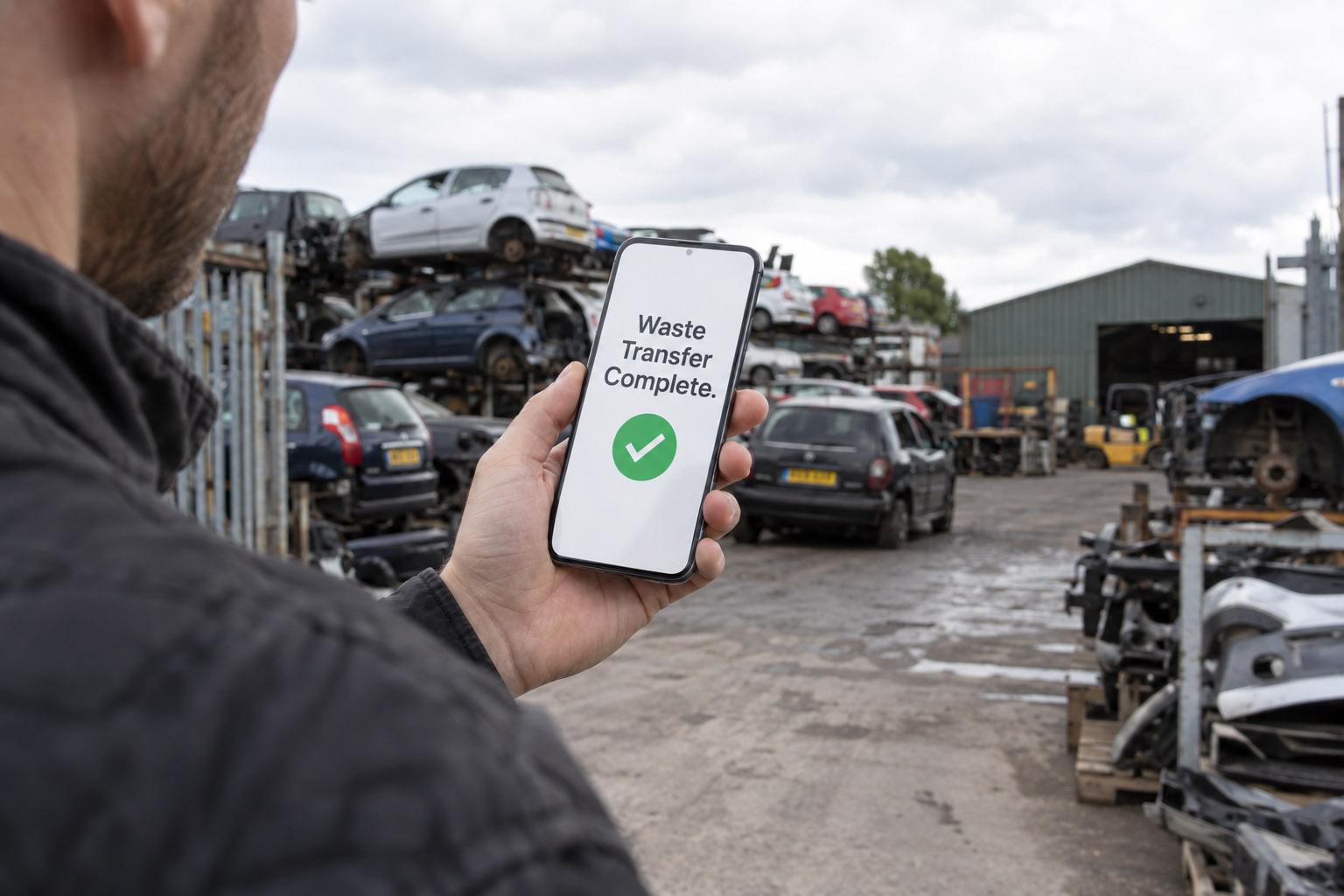
Digital Waste Tracking (DWT):
What UK waste businesses need to know
The way waste movements get recorded in the UK is changing. From October 2026, permitted waste receiving sites in England and Wales must report every load through a new digital service. Below, we answer the questions we’re hearing most from the industry.
Oct 2026
Jan 2027
2 working days
The rollout, step by step
Digital Waste Tracking (DWT) is being introduced in two phases. Phase 1 applies to sites that receive waste. Phase 2 applies to carriers, brokers and dealers.
April 2026
October 2026
January 2027
October 2027
The basics
Digital Waste Tracking, or DWT, is a new government service for recording waste movements in the UK. It’s designed to bring the current paper based system, built around waste transfer notes and hazardous waste consignment notes, into one digital record submitted straight to Defra.
It’s being delivered by the Environment Agency, working alongside the Scottish Government, Welsh Government and DAERA in Northern Ireland.
Waste crime costs the UK economy an estimated one billion pounds a year. It damages the environment, affects local communities and makes it harder for legitimate businesses to compete on a level playing field.
A digital record for every load gives regulators much better visibility of where waste actually goes, and makes illegal operators easier to identify at the roadside or on site.
Yes. Phase 1 covers hazardous and non-hazardous waste through one unified process.
If the waste you handle contains persistent organic pollutants (POPs), chemical substances that don’t break down in the environment, you’ll need to record this too. Under your Waste Duty of Care, it’s your responsibility to know whether your waste contains POPs. If you’re not sure, you can:
- Check the government guidance on identifying and classifying POPs
- Ask the supplier or manufacturer of the material
- Test the material yourself
- Get it analysed by a laboratory
Who it affects, and when
Phase 1 applies to waste receiving sites: any site operating under an environmental permit or waste licence that takes waste in. That includes sites run by vehicle recyclers, scrap metal dealers, treatment facilities and household waste recycling centres handling commercial waste.
The receiving site is responsible for reporting. If you send waste to a permitted site, the obligation to submit the DWT record sits with the site taking it in, not with you.
Not in phase 1. The service currently only applies to sites operating under a full permit or licence. Waste exemption holders are expected to be brought into the service in phase 2, though the government hasn’t confirmed a date for this yet.
They’re covered under phase 2, which runs on its own timeline. Private testing with an invited group starts in autumn 2026, the service opens to the public in spring 2027, and it becomes mandatory from October 2027.
Phase 2 will also bring in waste exemptions, and green list waste exports and imports.
What you need to do
For each load of waste received, you’ll need to record details including:
- who handled the waste, known as the carrier, and their waste carrier registration number
- your own details as the receiver
- the date the waste was received
- how it was transported, plus the vehicle registration if it arrived by road
- a description of the waste, including its physical form
- whether it’s hazardous, and whether it contains POPs
- the correct European Waste Catalogue (EWC) code
Getting your EWC codes and waste descriptions right matters. Using an inaccurate code, particularly on hazardous waste, can hold up your submission or create a compliance issue further down the line.
There are two routes.
If you already use waste management software, your provider can connect it to the Defra reporting API, so records get captured automatically as waste comes in and out.
If you don’t have software, there’s a spreadsheet upload method instead. This is a temporary solution while you get set up properly. The government currently expects to keep it available until at least October 2027.
You’re not excluded from the service. The spreadsheet method covers you for now, but it means logging details manually for every single load.
Given the volumes most permitted sites handle, and the two working day submission window, it’s worth looking into software that can automate this, even if you’re not ready to switch over straight away.
You have two working days from the day after you receive the waste.
For example, waste received on a Monday must be reported by 11.59pm on Wednesday. Waste received over a weekend must be reported by 11.59pm the following Tuesday.
A load left sitting unrecorded for weeks will still be dated from when it actually arrived, not when you get round to logging it. It’s worth building DWT into your daily routine rather than batching it up at the end of the month.
Costs, compliance and support
Yes, once it becomes mandatory. There’s an annual charge of £26 for any legal entity that creates or edits records in the service, which covers 12 months of access.
Reporting through DWT is a legal requirement once your site is in scope, not something optional. Missing the reporting window, or failing to register at all, is an offence.
Regulators enforce the rules in their own nation, whether that’s the Environment Agency, SEPA, Natural Resources Wales or NIEA, and can take action against sites that don’t comply.
You’ll need a Defra waste receiving account, accessed through your organisation’s Government Gateway or GOV.UK One Login. You can register now, ahead of the mandatory dates, through the report receipt of waste service on GOV.UK.
The Digital Waste Tracking helpline can help with general questions about the service and the spreadsheet submission method. They can’t advise on regulatory questions or specific software products, so for those you’ll need your regulator or your software provider.
Digital Waste Tracking helpline: 03000 203 781
Monday to Friday, 8am to 6pm
Getting ready for DWT
If you’re sending waste to us and want to make sure your carrier details and paperwork are in order before the changeover, our team is happy to talk it through with you.
This page is general information, not legal or regulatory advice. It reflects UK government guidance on GOV.UK, last updated 5 August 2026. Requirements can change as the service moves through public beta, so always check the official guidance or speak to the Digital Waste Tracking helpline before making decisions for your business.